
“Curiosity is a person’s preference for uncertainty and tolerance to information gaps from what is known and the unknown.”
Defining Curiosity.
It all begins with an idea. Maybe you want to launch a business. Maybe you want to turn a hobby into something more. Or maybe you have a creative project to share with the world. Whatever it is, the way you tell your story online can make all the difference.
Don’t worry about sounding professional. Sound like you. There are over 1.5 billion websites out there, but your story is what’s going to separate this one from the rest. If you read the words back and don’t hear your own voice in your head, that’s a good sign you still have more work to do.
Be clear, be confident and don’t overthink it. The beauty of your story is that it’s going to continue to evolve and your site can evolve with it. Your goal should be to make it feel right for right now. Later will take care of itself. It always does.
Abstract.
To address the question, "How might the products be designed to evoke curiosity in users?" the concept of curiosity and the five main principles of evoking curiosity were investigated.
The various approaches to apply the broad concepts of curiosity to product design, as well as their constraints and limitations, were examined using an iterative design research technique. The newly translated concepts for developing inquisitive items were then validated by applying them to the product and interaction design of two products (an audio system and a soap dispenser). The audio system's interactions were carried out using embedded machine learning. The effectiveness of the audio system to evoke curiosity in users and its usability are studied with user testing.
Research Goal.
The primary objective of this design research was to discover and demonstrate how products can be designed to arouse users' curiosity and create a more memorable product experience.
By applying the principles of curiosity to the design of an audio system, we will investigate various methods for eliciting users' curiosity and questioning behavior in order to increase user product engagement.
Different sources of curiosity and general principles of curiosity are analyzed through the lens of product design in order to comprehend "what does curiosity mean in product design?" And how can we create an end-user product that arouses interest and provides a superior user experience?”
This research utilizes literature review and design exercises to identify elements and areas in product design that have the potential to elicit user curiosity. Then, taking those principles and applying them to a new design brief to create a product that evokes curiosity, and testing and evaluating these principles through user testing and feedback.
Design research methods.
This study is organized around the Design Research Method methodological framework [5], which consists of four iterative stages (Figure 1): Research Clarification, Descriptive Study 1, Prescriptive Study, and Descriptive Study 2.
Descriptive study 1.
The structure of this research is exploratory and iterative in nature, with the objective of elucidating the question, "How can we create products that elicit curiosity and increase product engagement?"
We analyzed the literature and relevant works on curiosity, the elements that elicit curiosity, and the general principles of curiosity. Curiosity is a frequently used abstract concept in a variety of fields. The fields of arts, game design, advertisements, and education use curiosity in different levels to draw their audience. An interdisciplinary workshop on designing for curiosity [6], sponsored by Microsoft Research Inria Joint Center also sparked concerns and conversations about how to employ curiosity principles to build an end user application that elicits consumers' curiosity.
Researchers have already examined the relationship between curiosity and a variety of individual elements such as uncertainty, knowledge gap, and risk of failure through design explorations and experiments. The general principles of curiosity and product design are examined in order to have a better knowledge of the elements that influence these designs in these two areas. This also aided in the comprehension of the gaps in study areas shared by these two fields.
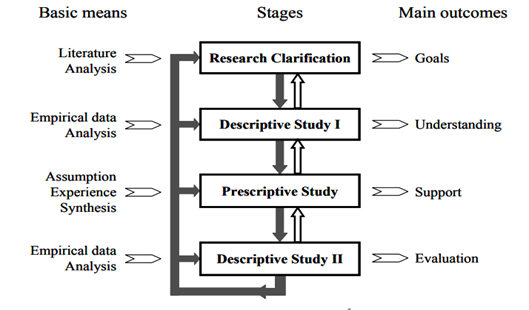
Figure 1 represents DRM Framework (Blessing and Chakrabarti.DRM, a design research methodology. Springer Dordrecht, 2009.)
Prescriptive study
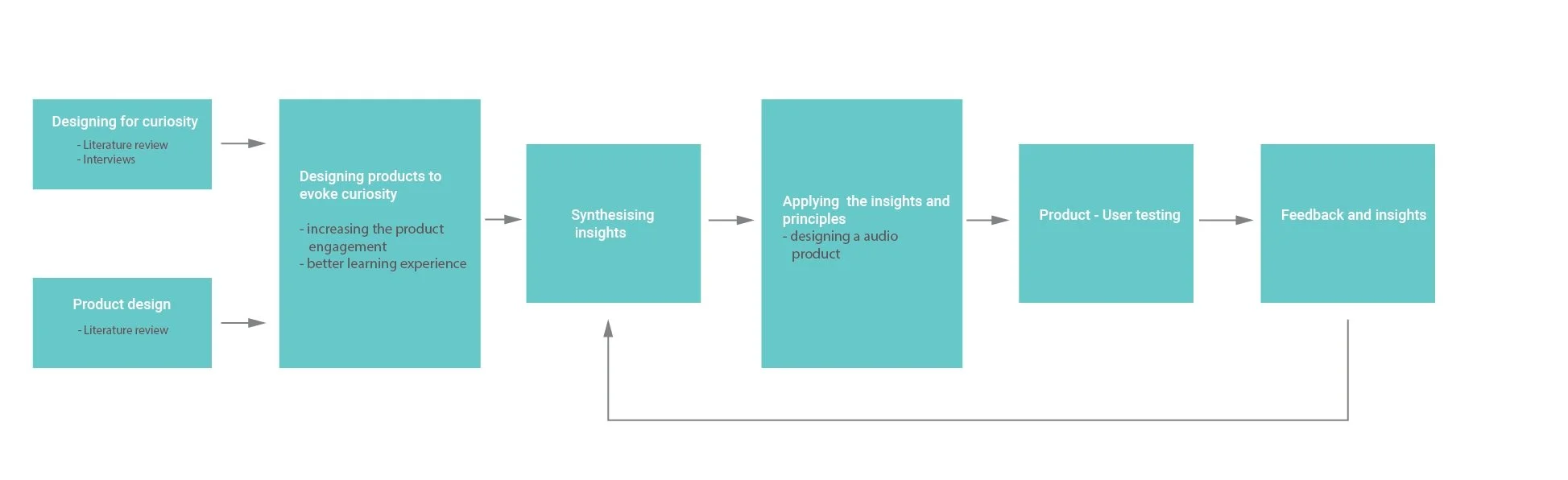
The primary research topic addressed in this part is “How to translate the general principles of curiosity to apply them in a product design context” The literature reviews and interviews on both Designing for curiosity and Product design were done to gain more insights related to designing products for curiosity. This discussion is synthesized into design principles and design elements to create curious products. These proposed design elements and principles were then applied to design and build an audio device. This overall research process is exploratory and iterative in nature, moving between the Descriptive study 1, Prescriptive study, and Descriptive study 2.
Descriptive Study 2
This research phase evaluates the impact of proposed design principles and elements on a real-world end user product. The audio device (speaker) is tested with users to determine how individuals react to the new design. The effectiveness of design elements in eliciting curiosity is examined. Additional user tests were conducted to determine the effect of the curious design on the product experience
Research Questions
1. How can the principles of curiosity be translated to a product design context?
2. How can elements of curiosity be used in conjunction with storytelling techniques to educate users about non-traditional product interactions and motivate them to interact with the product?
What is curiosity ?
For nearly half a century, the meaning of curiosity has been contested, and no single definition is agreed widely. Researchers are attempting to develop their definitions of curiosity based on their own interpretations and understandings gleaned from their research in different contexts. Here are a few ways researchers define curiosity; the definitions are not entirely distinct or unique, as they share some characteristics.
“Curiosity is a person’s preference for uncertainty and tolerance to information gaps from what is known and the unknown.” [7]
“Desire for new information, knowledge or skill without the expectation of any extrinsic reward or benefits.”
“Preference or tolerance for the uncertainty that motivates responses such as exploring, manipulating, and questioning”
“A state arising when attention becomes focused on a gap in one’s knowledge and there is a perceived ability and desire to close that gap” [ 7]
“Desire to explore novel, uncertain, ambiguous and complex events.”
“Openness to experience, novelty seeking, need for cognition, intrinsic motivation, tolerance of ambiguity, tolerance for uncertainty, frustration tolerance, and sensation seeking. “
Though we are all inquisitive, our levels of curiosity and the topics about which we are intrigued differ from person to person, scenario to scenario, emotional state of the person, lifestyle, prior knowledge of the issue, and so on.
Previous studies on Curiosity
Epistemic vs. Perceptual Curiosity: Epistemic curiosity is a motivator for people to learn new skills, fill in information gaps, and solve intellectual obstacles. Perceptual curiosity drives us to pay attention to new sensations and encourages visual or sensory examination. [9]
Curiosity and age: Kids, according to [10], are more intrigued about diversity than perceptual inquiry, but adults are more interested in epistemic curiosity. People's areas of curiosity may vary as they grow older; items that sparked your interest when you were ten may not excite you when you're forty.
Curiosity in design: Curiosity is employed in a variety of industries to attract and interest individuals, including game creation, advertising, education, art, and literature.
Throughout their games, game designers use many components to elicit curiosity, sustain user engagement, and motivate users to progress further in the game.
Alexandra et al. [11] discuss five different types of curiosity in game design and how games use different types of curiosities to provoke, control, and sustain players' curiosity throughout the game by “Integrating curiosity and uncertainty in game design.”
The five types of curiosity are [11]:
1. perceptual curiosity, 2. manipulatory curiosity, 3. curiosity in complexity or ambiguity, 4. conceptual curiosity, and 5. adjustive reactive curiosity.
Costikyan discusses many forms of uncertainty in his book "Uncertainty in Games” [12], which was inspired by a variety of sources and how these uncertainties are employed in games to pique players' interest and encourage them to participate in the game. [12]. He looked at a number of games, including Super Mario Bros., Rock/Paper/Scissor, Monopoly, Cityville, and others, and demonstrated how using uncertainty as a design aspect may improve user involvement and lead to a successful game. He also talks about how to employ features like performative uncertainty, complexity, and anticipation to create novel games. In games, areas designed to elicit user curiosity include creating mystery, sensory stimuli, storylines, and levels[13].
Aditya & Jaison [14] conducted a missing letter test to investigate the effect of uncertainty produced by information gaps, utilizing nine letter words with varying numbers (2, 4 and 7) of missing letters stimuli. The participants' curiosity and confidence levels were examined after they were asked to guess the missing letters. Following the disclosure of the right answer, their satisfaction levels were examined using self-rating and indirectly evaluated using the affect misattribution approach. The participants' interest levels were highest when they were confident and there was a small information gap (2 missing letters). Steven Houben and Weichel [2525] employed a "useless machine" as a curiosity object to boost people's engagement with public displays in order to reduce interaction blindness. They grabbed attention through the curiosity object and used that attention to educate people and encourage them to interact with public displays.
The five primary principles of curiosity as shown in Figure 3 and are summarized as follows: novelty, partial exposure, uncertainty, complexity, and conflict by [15] [16].
Product design and curiosity
Almost every one of us had the experience of breaking/disassembling a toy/object to see how it worked or what was inside when we were younger. We rarely gave importance/preference to keeping our toys/things undiscovered or safe while we were children. The desire to learn how it works or what's inside outweighs the desire to preserve the toy or object unharmed and safe. However, as things have become smarter, our curiosity has switched from how the product works to what it does and what features it has, such as examining the product's functionalities.
When learning is done in small steps, it is received by the listener's mind. Similarly, the steps between should be gradual and achievable, leading people from what they know to what they do not know. If the information/knowledge/skill gap is too wide, people are likely to give up and move on, and that object will no longer pique their interest. This is owing to the vast information gap that exists between their present familiar information and the knowledge needed to fulfill their curiosity.
How many of us have disassembled an object out of curiosity to see what is inside and then been stumped as to how to put it back together? Is it the fault of the user? It's because those items were never intended to be disassembled or reassembled outside of the factory. Let's pretend we're opening a watch to see how it works. Most people are familiar with the initial few steps of taking the watch and unscrewing a few screws to remove the cover. However, there is now a little gearbox inside. Many are hesitant to open and disassemble the gearbox because the knowledge and skill gap between what they are now and what they want to be is large. The dread of a massive information gap outweighs the desire to learn more. Smaller the information gap, more curious people are to learn more it. Curious designs elicit perceptual curiosity in users, causing them to interact instinctively with the product, resulting in a memorable product experience.